
The Critical Importance of Pharmacy Refrigerator Temperature Monitoring
Pharmacy refrigerators store highly temperature-sensitive items—such as biological products, vaccines, and insulin—which require an optimal storage range of 2°C to 8°C. Traditional paper-based monitoring is labor-intensive and prone to missed readings. Even traditional USB data loggers require opening the refrigerator to retrieve data; each time the door is opened, cold air escapes, causing internal temperature fluctuations that can compromise the safety of these high-value products. Bluetooth-enabled temperature monitoring allows for non-intrusive monitoring through the closed door and automatic data archiving on mobile devices, significantly enhancing both efficiency and reliability.
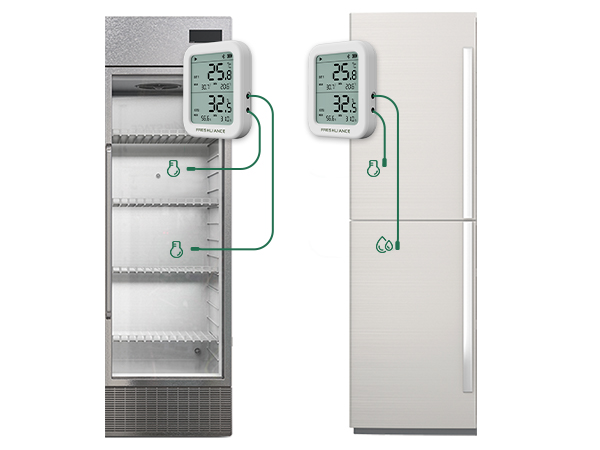
Why Bluetooth (BLE) is the Ideal Wireless Temperature Monitoring Solution for Pharmacy Fridges
While traditional USB data loggers meet pharmacy requirements regarding monitoring range and accuracy, the need to remove the device to read or analyze data causes temperature fluctuations. This not only affects data accuracy but can also compromise product quality. Bluetooth temperature data loggers revolutionize this process by pairing directly with a smartphone; users simply bring the app-enabled phone near the refrigerator to view real-time temperatures, historical data, complete temperature curves, and temperature excursion alerts—all without ever opening the refrigerator door. This wireless solution boosts monitoring efficiency while ensuring compliance with regulatory standards for pharmaceuticals and vaccines.
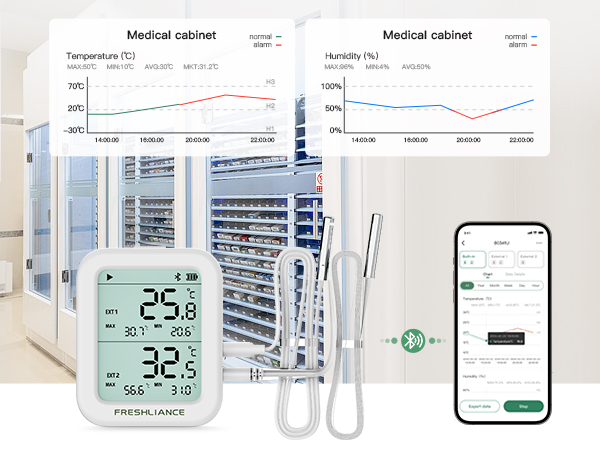
Recommended Bluetooth Loggers for Pharmacy Fridges
Freshliance specializes in the R&D and manufacturing of Bluetooth temperature data loggers, offering a range of models designed for various wireless monitoring scenarios. For pharmacy refrigerator applications, Freshliance recommends the BlueTag TH30 Bluetooth temperature and humidity data logger. This device monitors both parameters and features an LCD display. By utilizing an ultra-thin, flexible external probe, the main unit can be mounted outside the refrigerator while the probe is placed inside. This allows for flexible cable routing based on storage zones, ensuring the monitored data accurately reflects the conditions within the product storage area without compromising the refrigerator’s airtight seal. The Freshliance Tkeeper app is free to use, allowing users to configure parameters, retrieve data, and export reports directly. This eliminates the need to open the refrigerator door to check readings—resolving the cumbersome steps associated with manually recording data or connecting USB loggers to a computer. Once a pharmacy staff member retrieves the data, the latest information is uploaded to the cloud, enabling other users to access it remotely; this facilitates data sharing and significantly boosts data analysis efficiency.
Conclusion
Upgrading pharmacy refrigerator temperature monitoring using Bluetooth technology offers the optimal balance between regulatory compliance and operational efficiency. Freshliance’s Bluetooth temperature data loggers fully meet the requirements and standards for pharmacy refrigerator monitoring. For users requiring real-time monitoring, a combination of a Bluetooth gateway and Bluetooth loggers creates a system that enables remote data tracking and alert notifications, resulting in a more automated, visual, and efficient workflow.
Email: [email protected]
Phone: +86 15517160690
Whatsapp: +8615517160690
3/F, Bldg. 15, Jinrong Xinxi Keji Yuan, Airport Economy Zone, Zhengzhou, China 451162